


Spatial Prediction in Health
Médias estaduais escondem desigualdades territoriais; o mapa mostra onde a política precisa chegar.
- Status
- Ongoing
- Period
- 2019 – present
- Registration
- PLOS ONE 2023 · 2025
- DOI
- 10.1371/journal.pone.0288241
Space-time analyses (emerging hotspots, LISA, geographically weighted regression) of mortality and access — colorectal and lung cancer, respiratory cancers, amputations, tuberculosis — to flag priority areas for public policy.

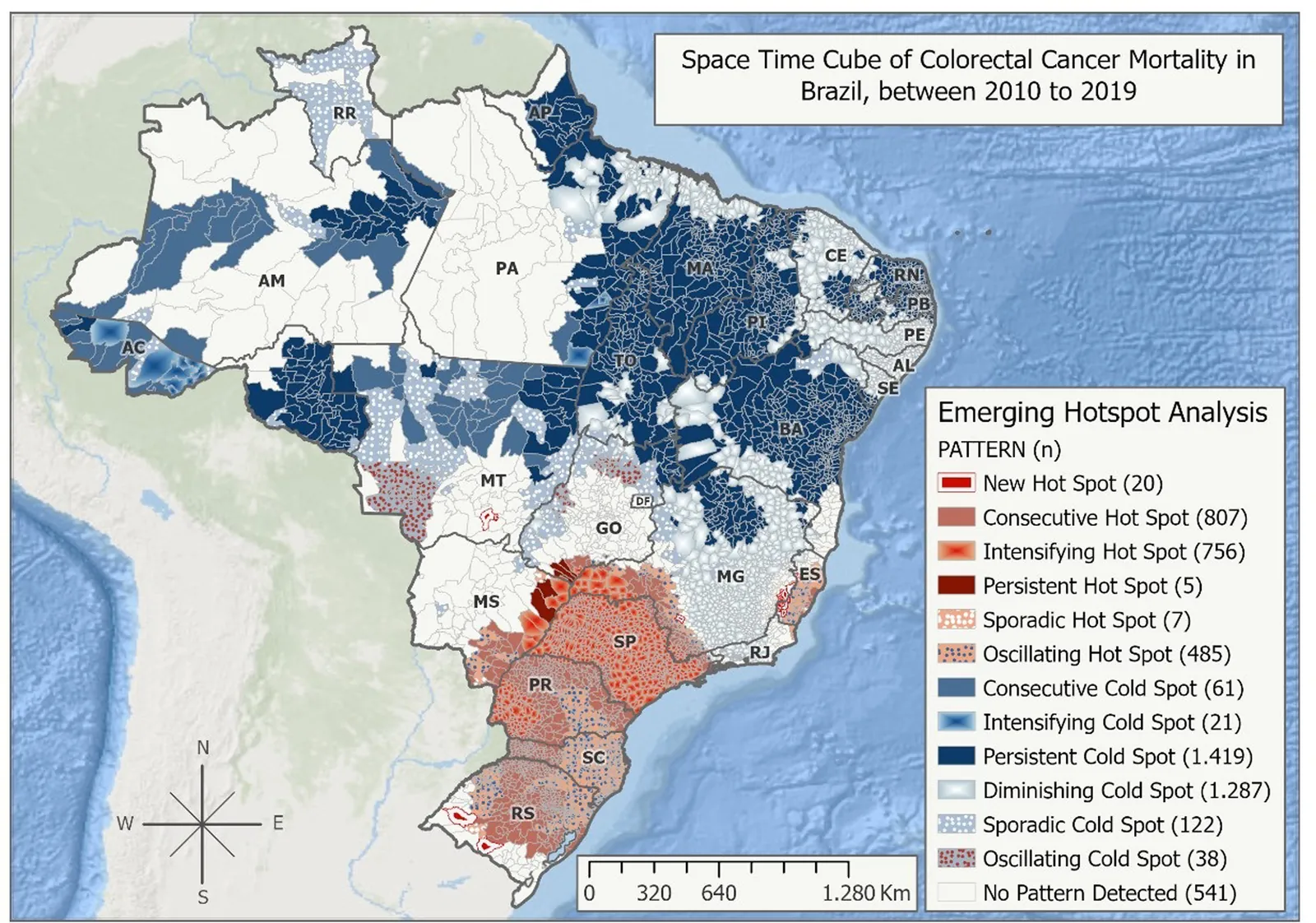
Emerging hotspot analysis pattern of colorectal cancer mortality in Brazil, between 2010 and 2019.
Figure from Spatial distribution of mortality from colorectal cancer in the southern region of Brazil — Matheus Jacometo Coelho de Castilho et al. · PLOS ONE · 2023 · 10.1371/journal.pone.0288241 — CC BY 4.0
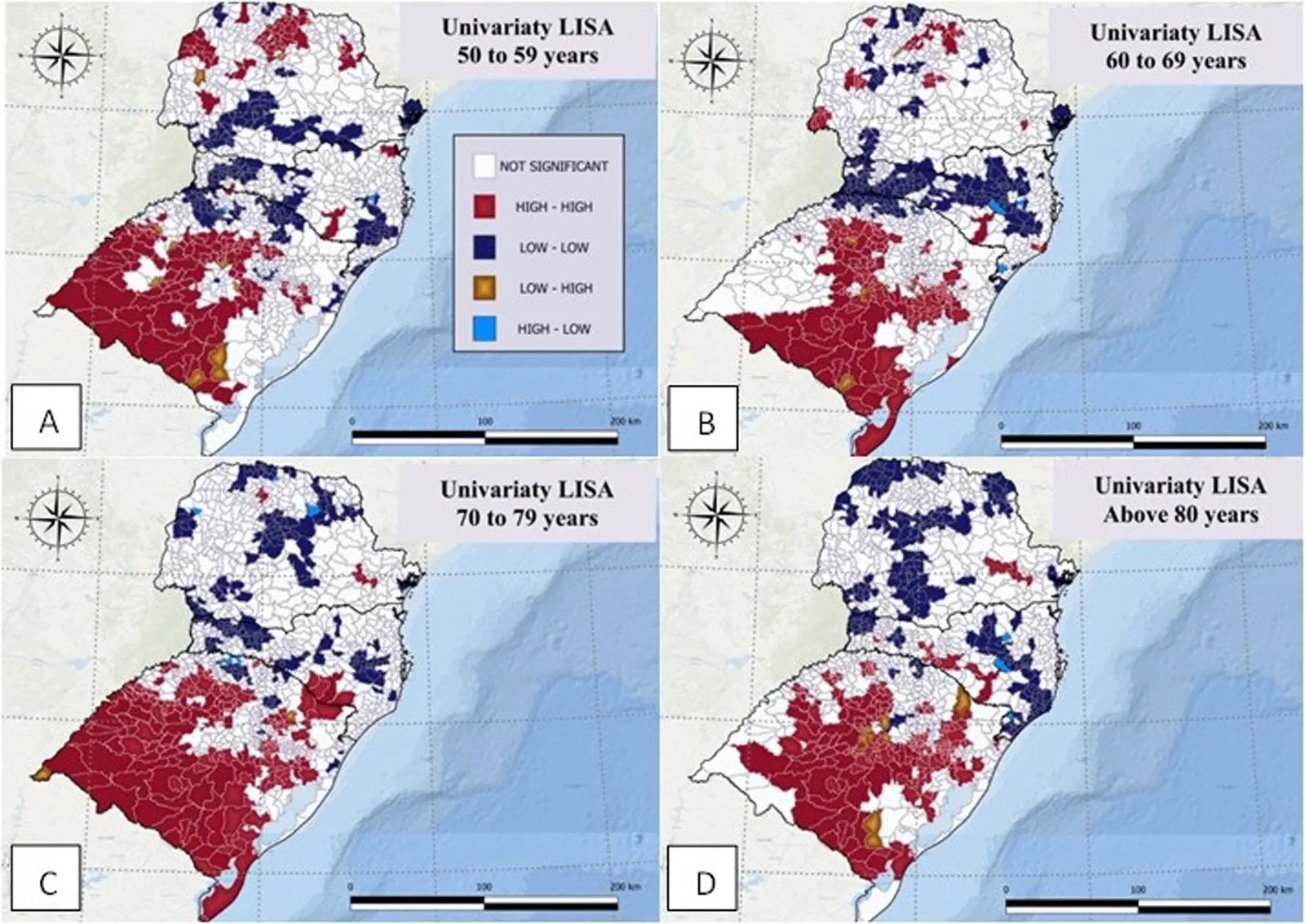
Local spatial association indicators (LISA) to identify possible deaths by colorectal cancer clusters, in Southern Brazil, between 2015 and 2019, for people aged 50 to 59 years (A), 60 to 69 years (B), 70 to 79 years (C), and 80 years old or above (D).
Figure from Spatial distribution of mortality from colorectal cancer in the southern region of Brazil — Matheus Jacometo Coelho de Castilho et al. · PLOS ONE · 2023 · 10.1371/journal.pone.0288241 — CC BY 4.0
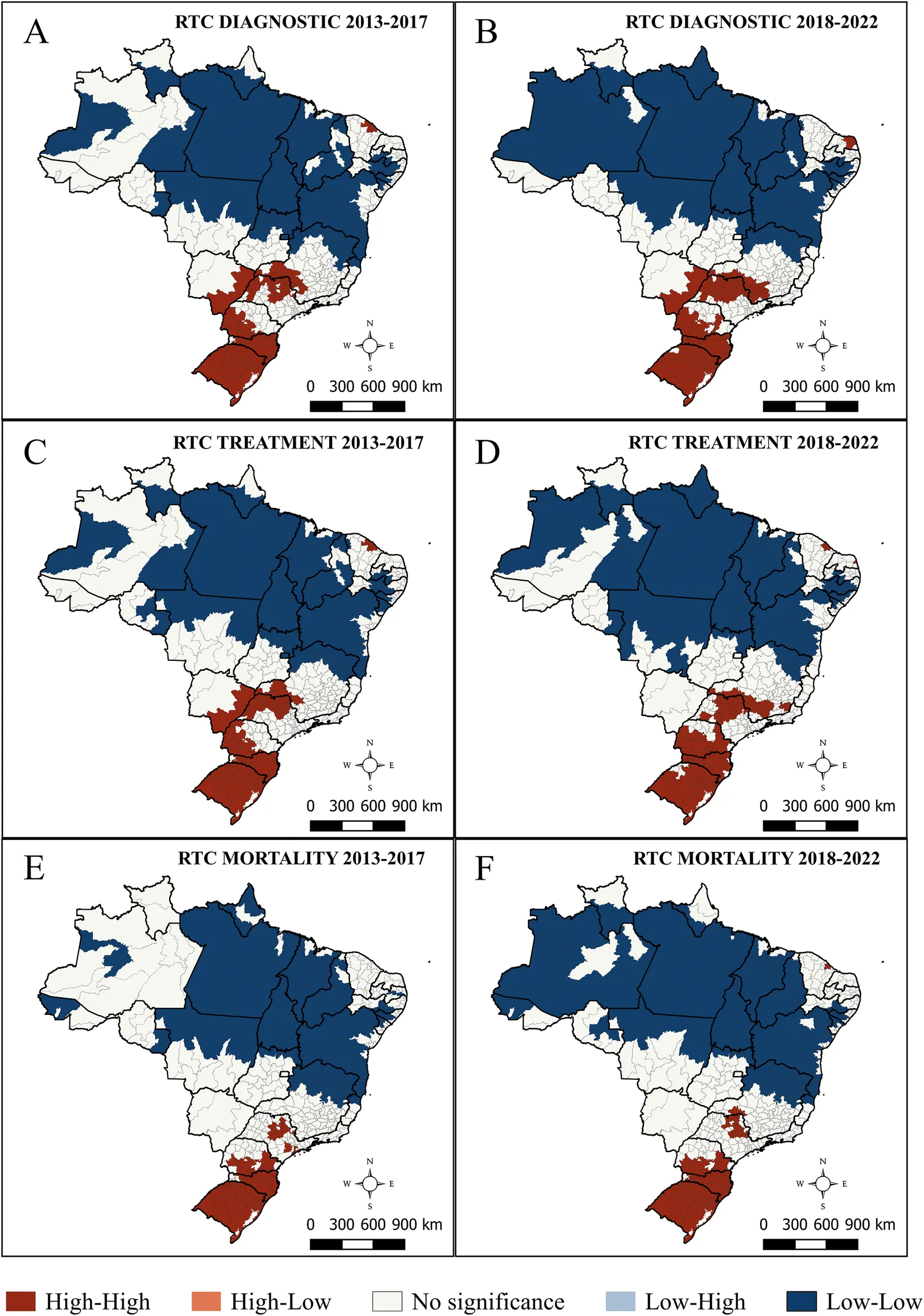
Local indicators of spatial association (LISA) for age-adjusted rates of respiratory tract cancers per 100,000 population among individuals aged 40–79 years in Brazil, stratified by administrative region.(A) Diagnosis rates from 2013 to 2017. (B) Diagnosis rates from 2018 to 2022. (C) Treatment rates from 2013 to 2017. (D) Treatment rates from 2018 to 2022. (E) Mortality rates from 2013 to 2017. (F) Mortality rates from 2018 to 2022.
Figure from Spatiotemporal disparities in the diagnosis, treatment, and mortality of respiratory tract cancers in Brazil — Miyoko Massago et al. · PLOS One · 2025 · 10.1371/journal.pone.0334115 — CC BY 4.0
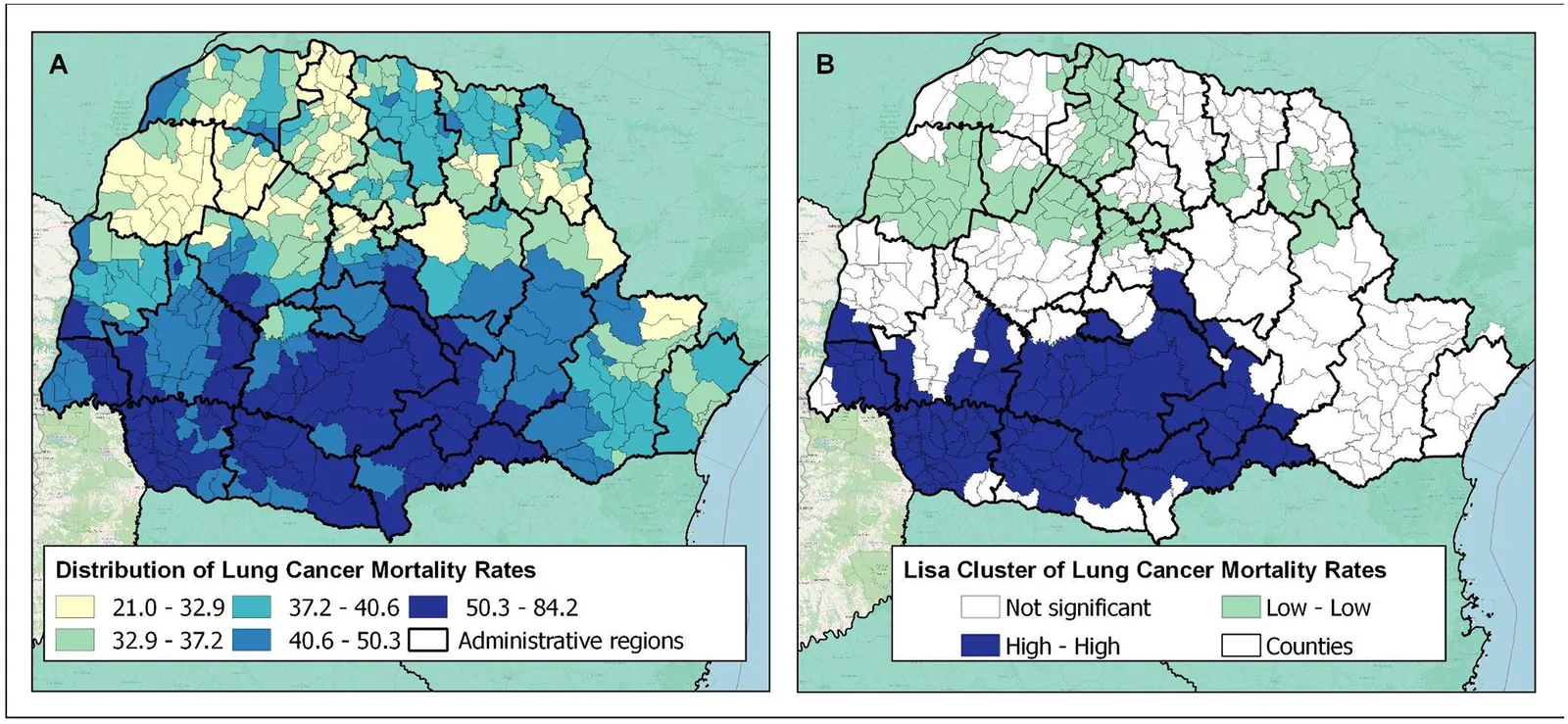
Spatial distribution of the lung cancer mortality (LC mortality) rate, between 2015 and 2019, in Parana, Brazil. A) LC mortality rates per 100,000 inhabitants (age-adjusted); B) location of high-high and low-low clusters according to LC mortality rates in Parana.
Figure from Exploring regional disparities in lung cancer mortality in a Brazilian state: A cross-sectional ecological study — Vlaudimir Dias Marques et al. · PLOS ONE · 2023 · 10.1371/journal.pone.0287371 — CC BY 4.0
- 2023Spatial distribution of mortality from colorectal cancer in the southern region of BrazilPLOS ONE · 11 authors · 1 citation10.1371/journal.pone.0288241Open the paper ↗
- 2025Spatiotemporal disparities in the diagnosis, treatment, and mortality of respiratory tract cancers in BrazilPLOS One · 14 authors · 1 citation10.1371/journal.pone.0334115Open the paper ↗
- 2023Exploring regional disparities in lung cancer mortality in a Brazilian state: A cross-sectional ecological studyPLOS ONE · 17 authors · 4 citations10.1371/journal.pone.0287371Open the paper ↗